
In March 2026, the Indian stock market has entered a phase of heightened volatility. Foreign investors have been rapidly withdrawing money from Indian equities, triggering market corrections and raising concerns among retail investors.
Foreign Institutional Investors (FIIs) have already sold over ₹52,700 crore worth of Indian equities in March 2026, including a single-day withdrawal of about ₹10,700 crore — the largest outflow of the year so far.
The big question for investors now is simple:
Why are foreign investors selling Indian stocks? And should retail investors be worried?
To understand what is really happening, we need to look beyond daily market movements and examine the global and domestic forces driving this sell-off.
Understanding FIIs and Their Role in the Market
Foreign Institutional Investors are global investment institutions such as:
- Pension funds
- Sovereign wealth funds
- Hedge funds
- Global asset managers
These investors allocate capital across different countries in search of better returns. Because they manage massive pools of money, their buying or selling decisions can significantly impact markets like India.
When FIIs invest heavily in India, markets usually rise due to strong liquidity. But when they start withdrawing funds, markets can fall quickly.
The Scale of the Current FII Selling
The selling pressure in March has been unusually strong.
Recent market data shows:
- Over ₹52,700 crore sold by FIIs in March 2026 so far.
- More than ₹21,000 crore withdrawn in just a few trading sessions amid global tensions.
- Overall FII selling in 2026 has already crossed ₹69,000 crore in the cash market.
This aggressive selling has contributed to sharp declines in Indian market indices and increased volatility.
But the sell-off is not happening in isolation.
It is driven by several powerful global factors.
1. Rising Oil Prices Are Hurting Market Sentiment
One of the biggest triggers behind the recent selling is the sudden rise in global crude oil prices.
Geopolitical tensions in the Middle East have pushed oil prices close to $100 per barrel, raising fears of supply disruptions.
For India, this is particularly concerning because the country imports nearly 85% of its crude oil needs.
Higher oil prices can lead to:
- Higher inflation
- Larger trade deficits
- Pressure on the Indian rupee
- Slower economic growth
When global investors see rising macroeconomic risks, they often reduce exposure to emerging markets like India.
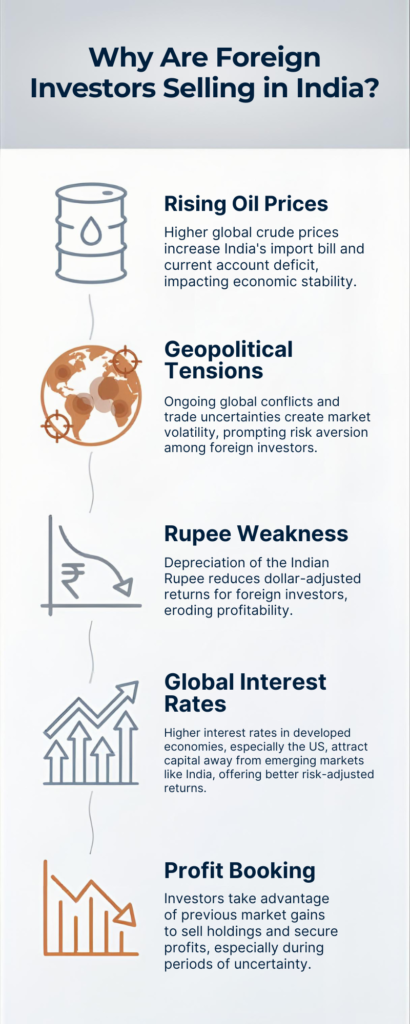
2. Global Risk-Off Sentiment
The ongoing geopolitical tensions involving Iran and Western countries have increased uncertainty across global markets.
These developments have triggered a “risk-off” environment, where investors shift money away from emerging markets into safer assets such as:
- US Treasury bonds
- Gold
- Developed market equities
Global conflicts have historically caused investors to pull capital out of riskier markets. The current situation is no different.
3. Weakening Indian Rupee
Another key factor driving FII outflows is the weakening of the Indian currency.
The rupee has depreciated significantly against the US dollar during the recent turmoil.
For foreign investors, currency depreciation reduces returns.
For example:
- If an investor earns 10% in Indian stocks
- But the rupee falls by 6%
The actual return in dollar terms drops dramatically.
To protect their capital, many global funds exit the market when the currency weakens.
4. Profit Booking After a Strong Market Rally
India’s stock market has delivered strong returns over the past few years, attracting large foreign investments.
However, after a strong rally, FIIs often engage in profit booking.
When valuations become expensive compared to global markets, investors rebalance their portfolios.
This does not necessarily mean they are bearish on India long term — it may simply be a tactical reallocation of capital.
5. Higher Interest Rates in Developed Markets
Another reason for FII outflows is rising interest rates in developed economies.
When US bond yields rise, global investors find it more attractive to park money in low-risk assets like government bonds rather than equities in emerging markets.
Historically, higher US interest rates have often led to:
- Capital outflows from emerging markets
- Currency depreciation
- Equity market volatility
Why the Market Has Not Collapsed Despite FII Selling
Interestingly, despite heavy foreign selling, the Indian market has not crashed dramatically.
The main reason is the growing strength of domestic investors.
Domestic Institutional Investors (DIIs) and mutual funds have been actively buying stocks and absorbing foreign selling pressure.
In recent sessions, domestic investors purchased significantly more equities than FIIs sold, helping stabilize the market.
This reflects a structural shift in India’s market dynamics.
India is gradually transitioning from a foreign-driven market to a domestically powered investment ecosystem.
Should Retail Investors Be Worried?
For long-term investors, the current situation should not be a cause for panic.
History shows that FII selling often creates short-term volatility but also long-term opportunities.
Several important points should be kept in mind:
Market corrections are normal
Every bull market experiences periodic corrections.
Strong fundamentals remain intact
India continues to have one of the fastest-growing major economies in the world.
Domestic participation is increasing
Millions of new investors are entering the market through mutual funds and SIPs.
Volatility creates opportunities
Long-term investors often benefit from buying quality stocks during corrections.
What Smart Investors Usually Do in Such Periods
Experienced investors generally follow a disciplined approach during volatile phases.
Instead of reacting emotionally, they focus on:
1. Continuing SIP investments
Regular investing allows investors to accumulate more units during market declines.
2. Avoiding panic selling
Selling during corrections often leads to permanent losses.
3. Focusing on high-quality businesses
Strong companies with durable competitive advantages tend to recover quickly.
4. Maintaining a long-term horizon
Wealth creation in equities typically happens over many years, not weeks.
When Could FIIs Return?
Foreign investors typically return when the following conditions improve:
- Geopolitical tensions ease
- Oil prices stabilize
- Currency volatility reduces
- Global interest rates decline
If these factors stabilize, India could once again attract significant global capital flows.
Given India’s strong economic growth prospects, many analysts believe the country will remain a key destination for global investors over the long term.
The Bottom Line
The recent FII selling in March 2026 is primarily driven by global macroeconomic factors such as rising oil prices, geopolitical tensions, currency fluctuations, and global portfolio rebalancing.
While these developments have created short-term market volatility, they do not necessarily indicate a structural weakness in the Indian economy.
For retail investors, the key lesson is simple:
Market volatility is inevitable, but long-term investing discipline is what ultimately creates wealth.
Instead of fearing corrections, investors should view them as opportunities to accumulate high-quality businesses at better valuations.
Want to understand the stock market in a simple and practical way?
Check out my Stock Market Knowledge Course, where I explain investing, company analysis, and long-term wealth creation step by step.
📊 Investor Reflection
Big market movements often create noise. But smart investors always pause and ask a few important questions before reacting.
- Is this market movement driven by short-term news or long-term fundamentals?
- If foreign investors are selling, who is buying?
- Has the actual business performance of companies changed?
- Am I reacting emotionally or thinking like a long-term investor?
The stock market rewards patience more than speed. The best investors often ask better questions before making decisions.
Take a moment to think about these questions before your next investment decision.