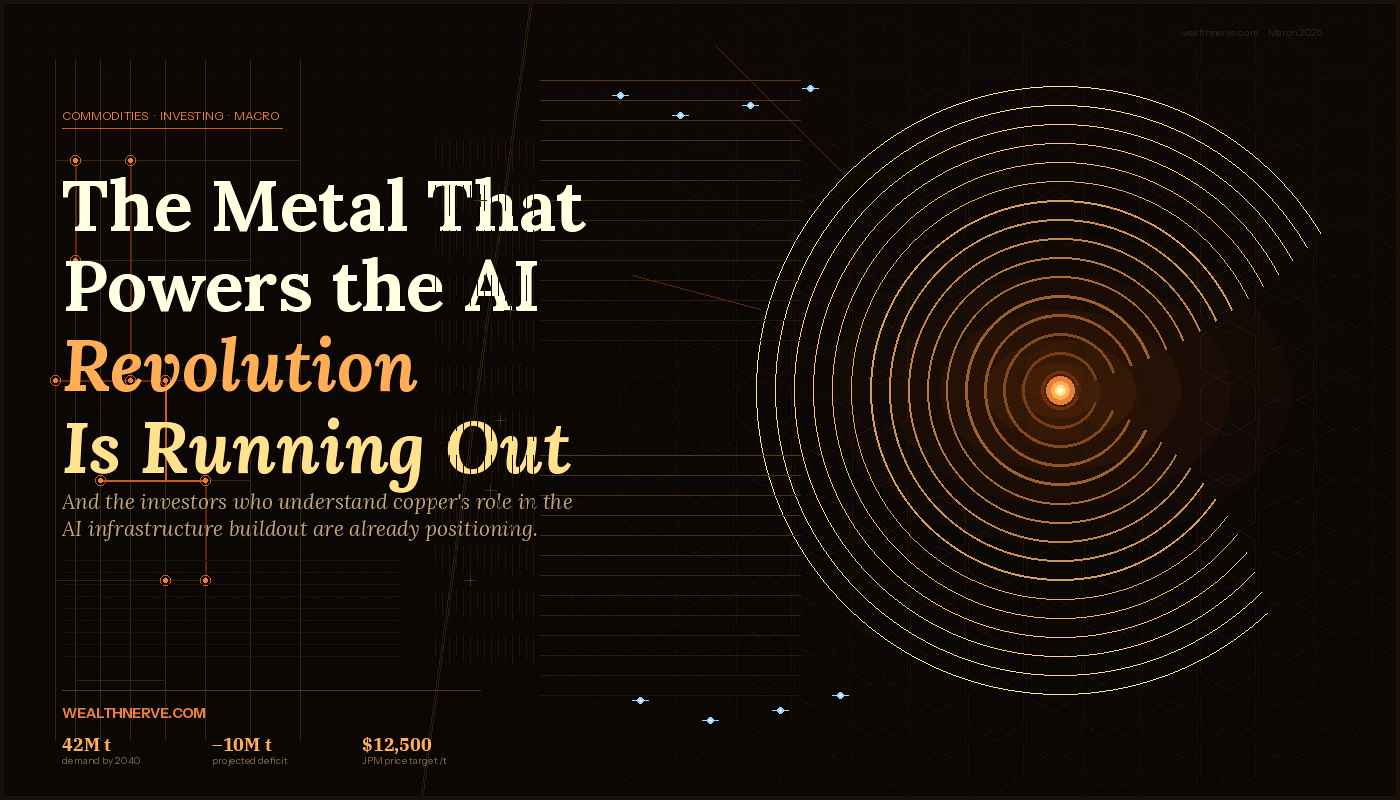
The Metal That Powers the AI Revolution Is Running Out — And Investors Are Taking Notice
There’s a quiet crisis developing beneath the surface of the AI boom — one that has nothing to do with chips, models, or software. It’s about a reddish-brown metal that has been mined for more than 10,000 years. That metal is copper.
Why Copper? Why Now?
Most people hear AI investing and immediately think about Nvidia, Microsoft, or advanced chips. But building the infrastructure that powers AI — data centers, power grids, cooling systems and transformers — requires enormous amounts of copper.
An AI-optimized hyperscale data center can consume up to three times more copper than traditional facilities. Some estimates suggest as much as 50,000 tonnes per facility.
The Supply Side Has a Problem
S&P Global projects copper demand could reach 42 million tonnes by 2040 — about 50% higher than today. But supply is struggling to keep up due to slow mine development, environmental approvals, and geopolitical constraints.
Developing a new copper mine can take 15–20 years from discovery to production. That means the supply pipeline cannot react quickly enough to the electrification boom.
The AI–Copper Connection
Data centers are only one driver. Electric vehicles use roughly four times more copper than traditional cars. Renewable energy grids also require massive copper cabling.
Copper Investment Pathways
| Investment Type | Examples | Upside |
|---|---|---|
| Copper Miners | FCX, BHP, SCCO | High leverage to copper price |
| Copper ETFs | COPX, CPER | Diversified exposure |
| Electrical Equipment | Eaton, ABB | Grid expansion demand |
- AI investment slowdown
- China demand weakness
- Trade policy disruption
- Commodity price volatility
What Investors Should Think About
The copper opportunity is not a short-term trade. It is a structural shift driven by electrification, artificial intelligence infrastructure, and global energy transition.
Market Wisdom
During the California Gold Rush, the biggest fortunes were made selling picks and shovels. In the AI revolution, copper may be playing that same role.
Investor FAQ — Understanding the Copper Opportunity
FAQWhy is copper so important for AI infrastructure?
Artificial intelligence relies on enormous data centers that require massive electrical power. Copper is the most efficient conductor used in electrical wiring, transformers, cooling systems, and grid connections. Every AI data center requires thousands of tonnes of copper for power distribution and connectivity.
How much copper demand could AI actually create?
Estimates vary, but several industry forecasts suggest AI-related data centers alone could consume more than 500,000 metric tons of copper annually by 2030. While that may seem small compared to global production, the growth rate is extremely rapid and adds pressure to an already tight supply market.
Why can’t mining companies simply produce more copper?
Developing a new copper mine is a long process. It can take 15–20 years from discovery to full production due to geological studies, environmental approvals, infrastructure construction, and financing. Because of these long timelines, supply cannot increase quickly even when demand rises sharply.
Which sectors benefit the most from rising copper demand?
Several industries benefit from rising copper demand including copper mining companies, electrical equipment manufacturers, recycling and secondary smelters, and exchange-traded funds (ETFs) that track copper prices or copper miners.
Is investing in copper miners risky?
Yes. Mining companies can be highly sensitive to commodity price swings, operational disruptions, and geopolitical risks in producing countries. While rising copper prices can significantly increase profits, falling prices can reduce margins just as quickly.
Could other metals replace copper?
Aluminum can replace copper in certain electrical applications because it is cheaper and lighter. However, copper remains more efficient for high-performance electrical systems, which is why it is still the preferred metal for many power infrastructure and data center applications.
Is the copper shortage happening right now?
Some analysts believe the market could enter structural deficit within the next few years, while others believe the largest shortages may appear closer to the end of the decade. What is clear is that long-term demand from electrification and AI infrastructure is rising faster than supply growth.