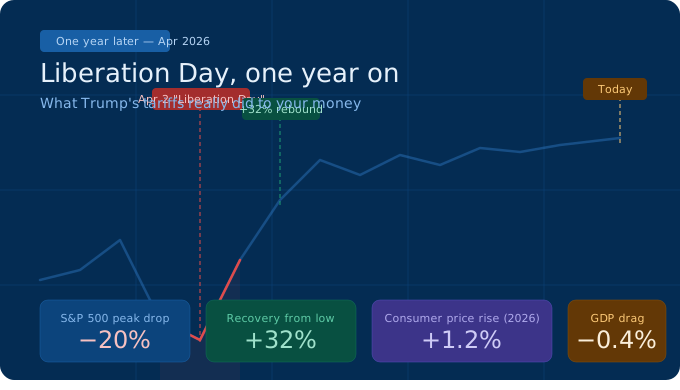
April 2, 2026 marks exactly one year since President Trump unveiled his sweeping “Liberation Day” tariff announcement — one of the most consequential economic moments of the past decade. One year on, the dust has only partially settled, and the full economic bill is now arriving at the doorstep of everyday Americans. Here’s an honest, data-driven look at what actually happened, where markets stand today, and what smart investors should do right now.
The Day That Shook Wall Street
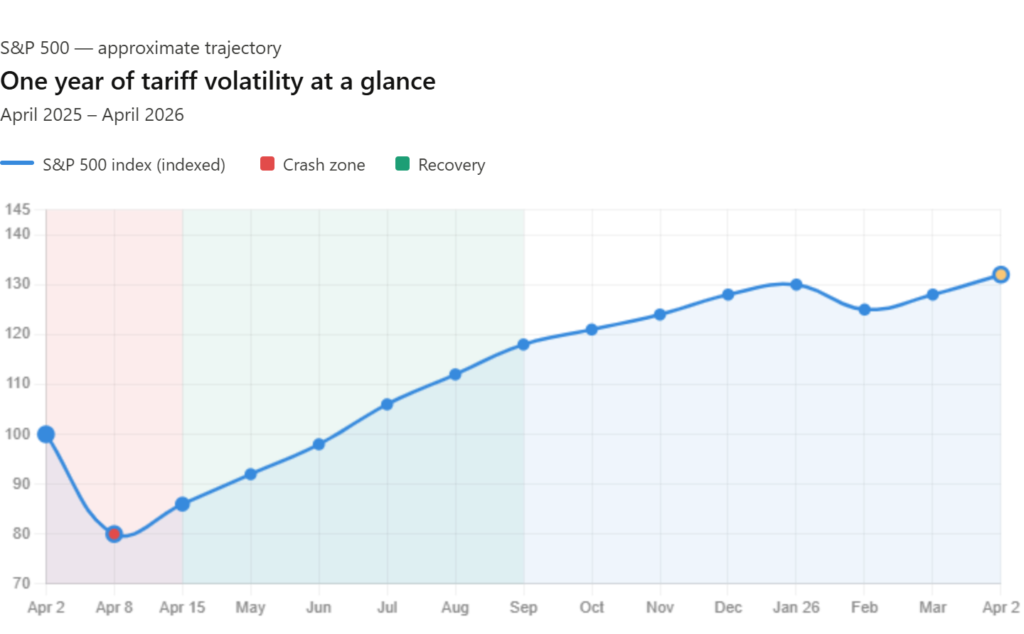
In 2025, tariff announcements and shifting trade rules triggered a sharp selloff, with the S&P 500 falling nearly 20% in seven weeks around the April 2 “Liberation Day” briefing. U.S. Bank It was a gut-punch for investors who had grown comfortable in a bull market that seemed unstoppable.
The S&P 500 experienced one of its worst two-day declines in history following the announcement. The Nasdaq Composite fared even worse. The only thing that prevented the indexes from falling into bear-market territory was the President’s reversal of many of the tariffs announced just days prior.
But after the initial panic? Markets snapped back hard. The market rebounded 32% from its April 8 low and remains near all-time highs despite a recent pullback as of March 25, 2026.
So why is there still so much anxiety? Because markets moved fast — but the real economy moves slow.
Who Is Actually Paying for the Tariffs?
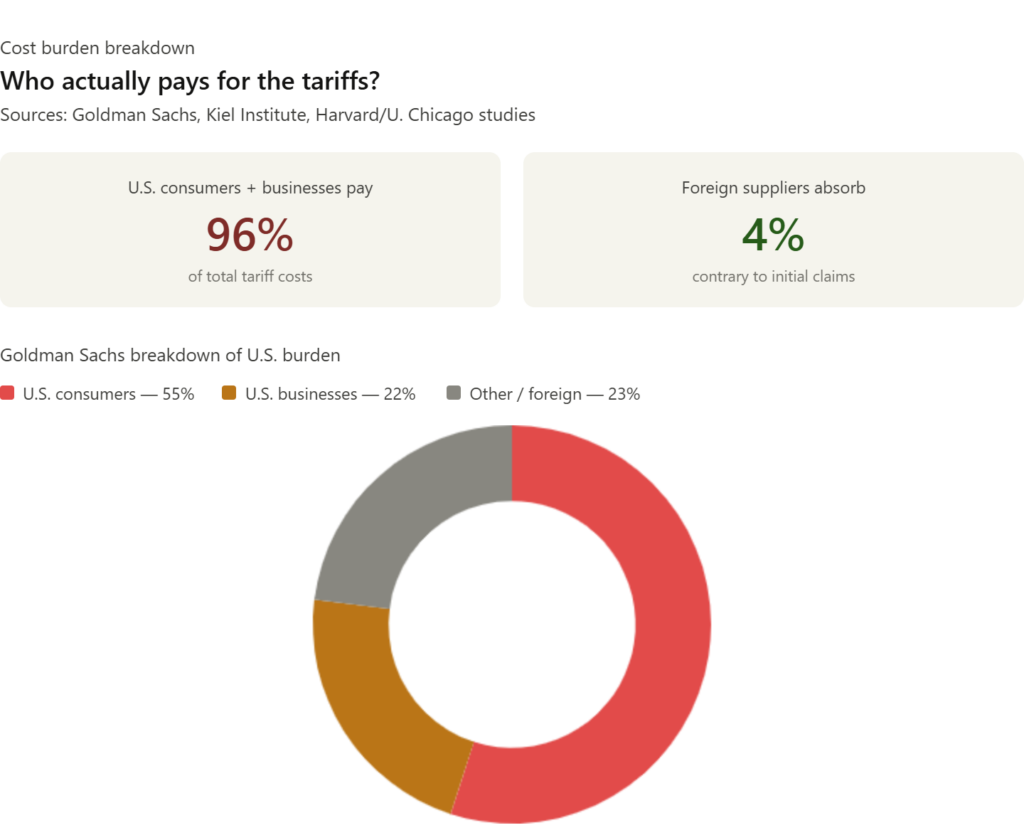
This is the question that matters most for your wallet. The Trump administration argued that foreign suppliers would absorb the cost. The data tells a very different story.
A study from the German think tank Kiel Institute estimates that U.S. businesses and consumers pay 96% of the tariff costs. This echoes a previous study by Harvard University and the University of Chicago Business Schools, which reached the same conclusion. Goldman Sachs economists estimate U.S. consumers will absorb 55% of the tariff costs, with U.S. businesses taking on another 22%. Nasdaq
In plain terms: when tariffs go up on imported goods, the price tag at checkout goes up too — and it’s American shoppers footing the bill.
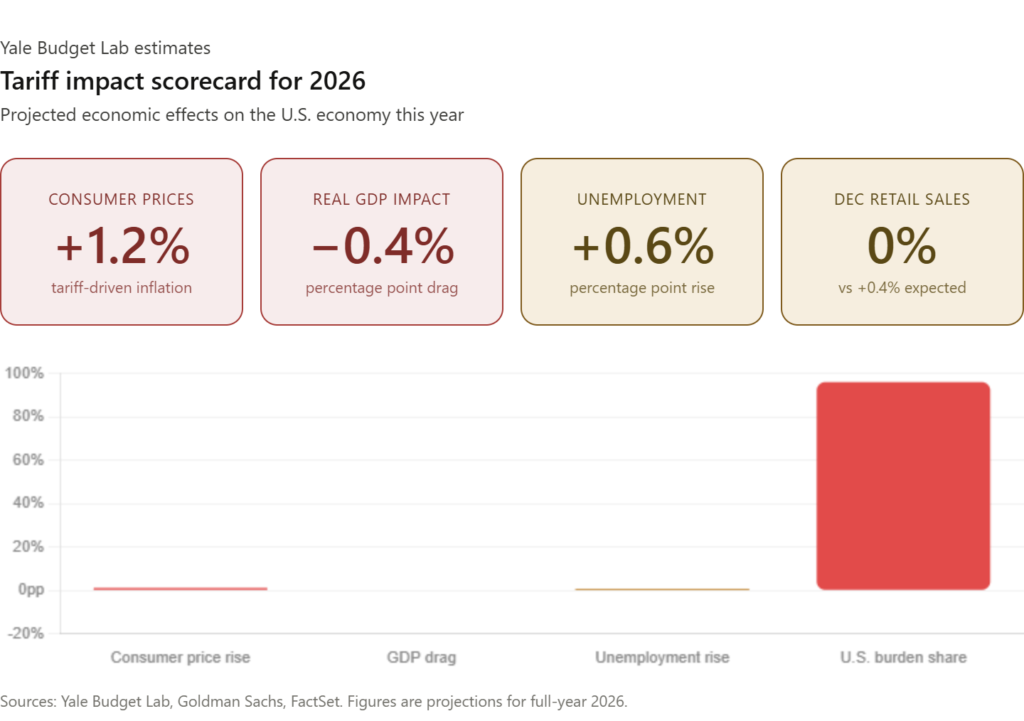
The Yale Budget Lab estimates consumer pricing will rise 1.2% in 2026 due to the impact of tariffs alone. They also estimate tariffs will result in a negative 0.4 percentage point impact on real GDP in 2026, and increase unemployment rates by 0.6 percentage points. Nasdaq
These are not catastrophic numbers in isolation — but they compound. A slower economy, sticky inflation, and rising unemployment is a combination that makes the Federal Reserve’s job significantly harder, and that tension ripples directly into stock prices.
The Inventory Shield Is Gone in 2026
Here’s a critical point that many casual investors missed: the tariff pain in 2025 was cushioned by a one-time buffer. Companies had pre-stocked inventory before tariffs hit. That shield is now gone.
The inventory stockpiling that reduced the impact of tariffs on consumers in 2025 won’t help this year. This could result in more companies passing higher prices from tariffs on to their customers in the coming months. BlackRock believes this scenario will play out this year. If so, this could cause inflation to rise and make the Federal Reserve less likely to cut interest rates. The Globe and Mail
Morningstar shares that concern. The financial services company predicts that inflation will increase in 2026 as American consumers bear a greater share of the burden of higher prices resulting from tariffs. The Globe and Mail
For investors, this matters enormously. The Fed cutting rates has been one of the key tailwinds for stocks over the past year. If tariff-driven inflation forces the Fed to pause or reverse, that tailwind disappears.
Why Hasn’t the Market Crashed Then?
Fair question. The economic headwinds are real — so why are stocks still near all-time highs?
Investors did not need every risk to disappear before buying stocks again. Instead, they regained confidence that businesses could adjust and grow profits, and that the consumer and economy could absorb policy changes better than many expected. U.S. Bank
There’s also the AI factor. AI optimism has so far carried the stock market and data-center construction has bolstered investments, Time even as tariff-sensitive sectors have struggled. The technology boom has effectively been running interference for the broader market.
Investors have shifted their focus from volatility alone to economic impact. They now ask whether tariffs will materially change growth, inflation, and earnings rather than whether tariffs will simply rattle markets. U.S. Bank That’s a more mature, nuanced question — and it’s the right one to be asking.
The Supreme Court Wild Card
Layered on top of all of this is a legal battle that could reshape tariff policy entirely. The Supreme Court is currently reviewing a case that challenges how much authority the president has to impose tariffs. The decision could clarify whether Trump can use those powers broadly or whether limits apply. The ruling may affect how easily tariffs can be used in the future. Yahoo Finance
If the tariffs are struck down, more than $135 billion in collected revenue could become eligible for refunds, per J.P. Morgan. However, market analysts found that another round of tariff announcements could follow, which can prompt investors to reassess company costs, earnings expectations, and fiscal assumptions. Yahoo Finance
In other words, even a legal victory against the tariffs may not end the uncertainty — and markets hate uncertainty more than they hate bad news.
What Smart Investors Are Doing Right Now
Given all of this, here are the moves that analysts and financial strategists are pointing to:
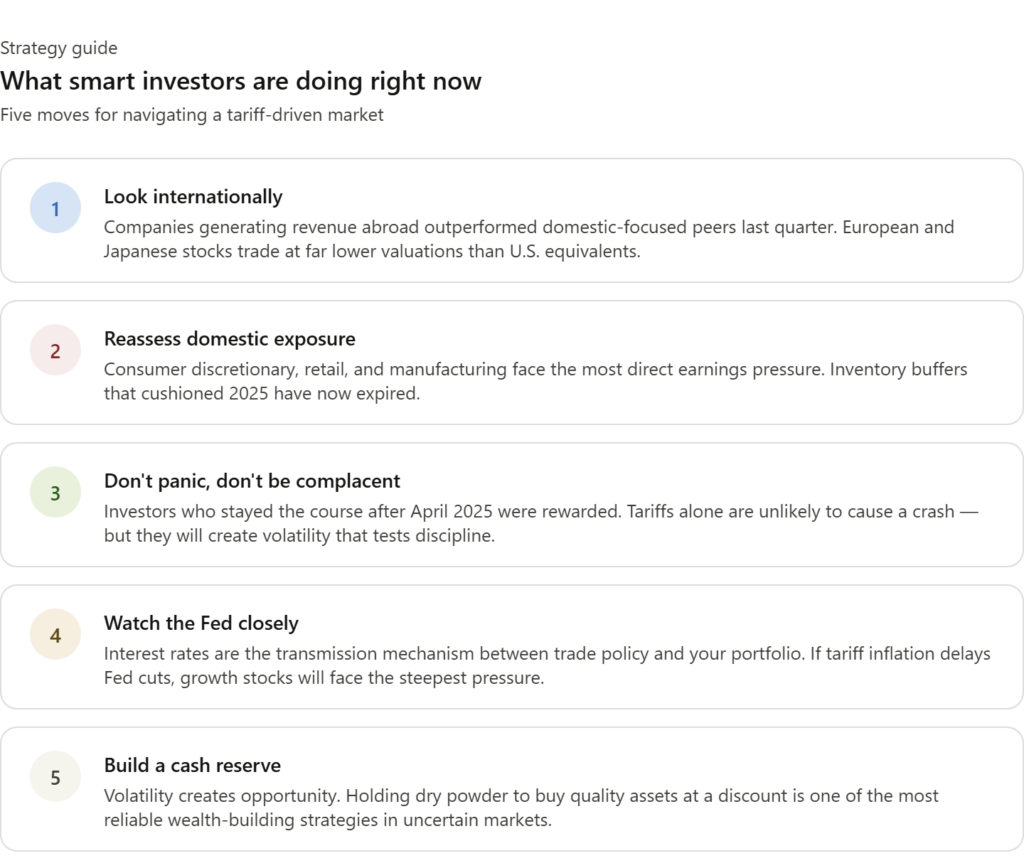
1. Look internationally. Companies that generate the majority of their revenue outside the U.S. saw stronger earnings growth than those operating mostly in the U.S. last quarter, according to data from FactSet Insight. Nasdaq European and Japanese stocks, which trade at far lower valuations than their American counterparts, are drawing fresh interest.
2. Reassess domestic exposure. Tariff-sensitive sectors — consumer discretionary, retail, and manufacturing — face the most direct earnings pressure as inventory buffers expire. Review your holdings for overconcentration there.
3. Don’t panic, but don’t be complacent. Tariffs could weigh on stock prices in 2026 and create uncertainty. However, they probably won’t cause a crash on their own. The Globe and Mail Long-term investors who stayed the course after April 2025 were rewarded. That lesson is worth remembering.
4. Watch the Fed. Interest rates are the transmission mechanism between trade policy and your portfolio. If tariff-driven inflation delays further Fed cuts, growth stocks will face the most pressure.
5. Build cash reserves. Volatility creates opportunity. Having dry powder available to buy quality stocks at a discount is one of the most reliable wealth-building strategies in uncertain markets.
The Bottom Line
One year after Liberation Day, the verdict on tariffs is nuanced: markets recovered, but the economic costs are real and still accumulating. The stock market’s resilience has been remarkable — but it has been propped up by AI optimism and consumer adaptability that may be tested harder in the months ahead.
The negative consequences are being stretched over a longer period of time. Negative impacts are currently being offset by low levels of retaliation and high levels of AI investment. Time That offset won’t last forever.
For everyday investors, the message is clear: stay informed, stay diversified, and resist the urge to make dramatic moves based on headlines. The investors who thrived after April 2025 weren’t the ones who sold everything — they were the ones who understood the difference between short-term noise and long-term fundamentals.
The next 12 months will test that discipline once again.