A mutual fund pools money from thousands of investors and invests it in stocks, bonds, or other securities. A professional fund manager handles all the investing on your behalf.
Think of it like a pizza 🍕 — many people contribute money (ingredients), a chef (fund manager) prepares it wisely, and everyone gets a slice proportional to what they put in.
👥
Pooled money
Thousands of investors contribute small amounts to create a large investable corpus.
🧑💼
Expert management
A SEBI-registered fund manager makes all buy/sell decisions for you.
🌐
Diversification
Your money is spread across 30–100 securities, reducing single-stock risk.
🔓
Liquidity
Most funds allow you to redeem your units on any business day within 1–3 days.
⚙️How Mutual Funds Work
Understanding NAV (Net Asset Value) is key to knowing what your investment is worth.
1
You invest ₹1,000
Money goes to the Asset Management Company (AMC) like SBI MF, HDFC MF, etc.
2
Units are allotted
If NAV = ₹50, you get 20 units. NAV is the price of one unit of the fund.
3
Fund manager invests
Your pooled money is invested in a diversified portfolio of stocks or bonds.
4
NAV changes daily
As the portfolio grows, NAV increases. If NAV becomes ₹60, your ₹1,000 is now ₹1,200.
5
You redeem anytime
Sell your units at the current NAV and money is credited to your bank in 1–3 days.
✅ NAV Formula: NAV = (Total Assets – Liabilities) ÷ Total Units Outstanding. A higher NAV doesn’t mean the fund is expensive — it just means it has grown more over time.
📊Types of Mutual Funds
Funds are classified by what they invest in, how they’re structured, and their investment goal.
Fund Type
Invests In
Risk
Expected Return (10Y)
Equity Fund
Stocks / Shares
High
12–15% p.a.
Debt Fund
Bonds, T-Bills
Low
6–8% p.a.
Hybrid Fund
Mix of Equity + Debt
Medium
9–12% p.a.
Index Fund
Nifty 50 / Sensex
Medium
11–14% p.a.
Liquid Fund
Short-term Debt
Very Low
5–7% p.a.
ELSS Fund
Equity (Tax Saving)
High
12–15% p.a.
Open-ended Funds
You can buy and sell units at any time. Most mutual funds in India are open-ended.
Close-ended Funds
Launched through an NFO with a fixed maturity period (usually 3–5 years). Listed on NSE/BSE.
Interval Funds
Can be traded only during specific intervals. Combines features of open and close-ended funds.
Growth Funds
For long-term wealth creation. Reinvest profits. Ideal for retirement or children’s education.
Income / Dividend Funds
Distribute regular income to investors. Suitable for retirees who need steady cash flow.
Tax-saving Funds (ELSS)
Save up to ₹1.5 lakh tax under Section 80C. Mandatory 3-year lock-in period.
📈Risk vs Return — Visual Guide
Higher potential returns always come with higher risk. Choose based on your goal and timeline.
Debt/LiquidHybridEquityIndex/ELSS
🔄SIP — The Smart Way to Invest
A Systematic Investment Plan (SIP) lets you invest a fixed amount every month — like an EMI but for building wealth. It removes the need to time the market.
📅
Rupee Cost Averaging
When markets fall, you buy more units. When they rise, fewer units. Average cost stays low.
💪
Discipline
Auto-debit on a fixed date means you invest before you spend. Builds a strong savings habit.
🚀
Power of Compounding
Returns earn returns. Starting early, even with small amounts, creates massive wealth over time.
💸
Start Small
You can start a SIP with as little as ₹100–₹500/month. No large lump sum needed.
SIP vs Lump Sum — Which is better? SIP wins during volatile markets due to rupee cost averaging. Lump sum wins when markets are at a low. For most investors, SIP is the recommended approach as it removes emotion and timing from investing.
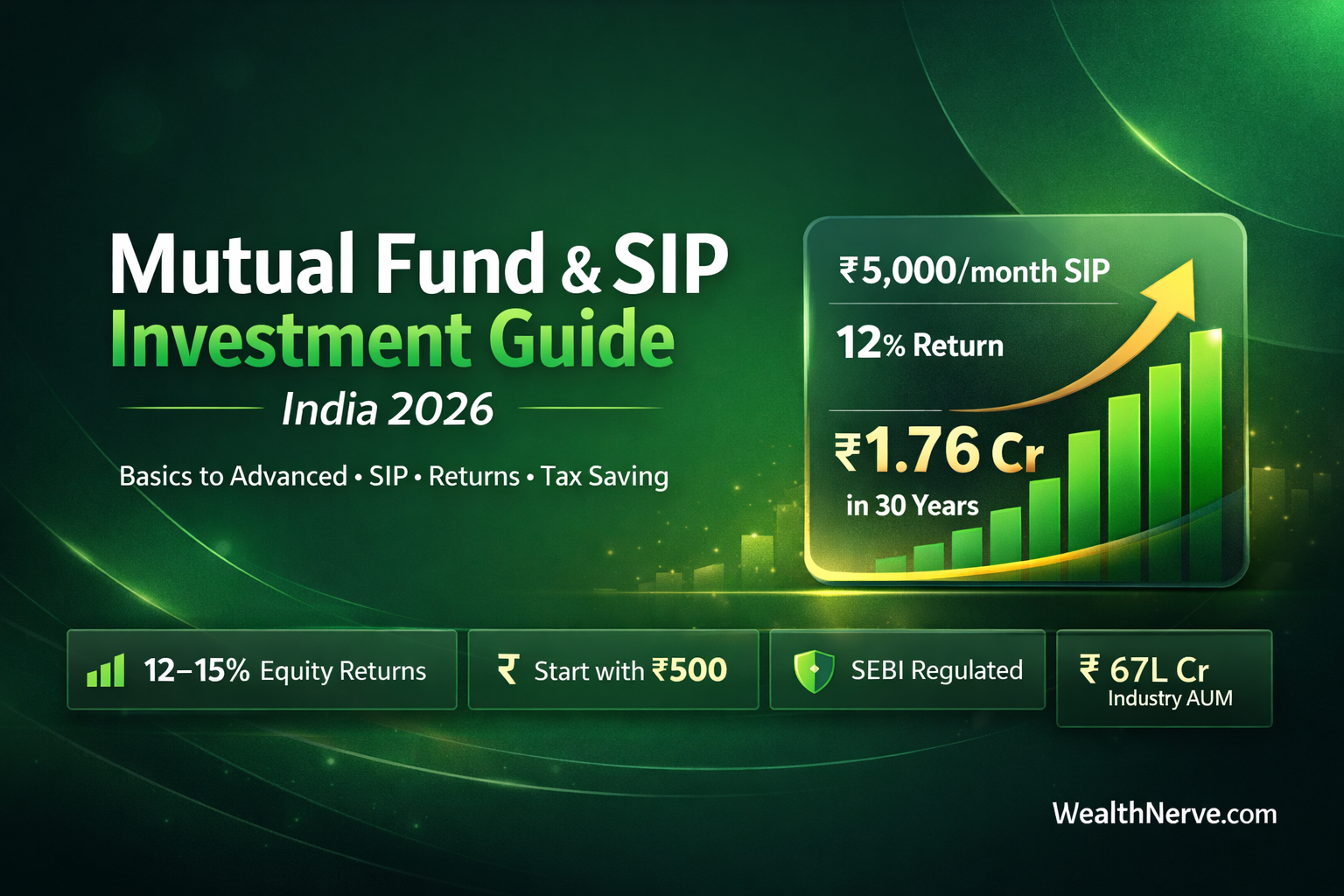
Power of Starting Early — ₹5,000/month SIP at 12% returns
Understanding these can significantly improve your actual returns.
Charge
What It Is
Typical Range
Tip
Expense Ratio
Annual fee for managing the fund
0.05% – 2.5%
Lower is better. Index funds charge ~0.1%
Exit Load
Fee for redeeming before a set period
0% – 1%
Avoid redeeming within 1 year
STT
Securities Transaction Tax (equity)
0.001%
Automatically deducted
Stamp Duty
On purchase of units
0.005%
Negligible
Taxation at a Glance
Fund Type
Holding Period
Tax Rate
Equity Funds
Less than 1 year
STCG: 15%
Equity Funds
More than 1 year (gains > ₹1L)
LTCG: 10%
Debt Funds
Any duration
As per income tax slab
ELSS
3-year lock-in
LTCG: 10% (80C benefit)
✅ Stay invested for more than 1 year in equity funds to benefit from LTCG (10%) instead of STCG (15%). Long-term investing saves tax AND compounds wealth.
⚖️SEBI Riskometer — Know Before You Invest
SEBI mandates every fund to display its risk level. Always check the riskometer on the fund’s fact sheet before investing.