By WealthNerve | March 20, 2026 | 9 min read
If you filled up your gas tank this week, you already felt it. Oil prices have gone from a quiet $62 a barrel at the start of 2026 to briefly touching $119 in the past two weeks — a surge not seen since Russia’s 2022 invasion of Ukraine. And unlike that spike, which faded within months, this one may stick around longer than most investors are prepared for.
Here’s everything you need to know about what’s driving oil higher, which stocks are winning and losing right now, and — most critically — what you should actually do with your portfolio today.
What Just Happened? The Strait of Hormuz Is Effectively Closed
The trigger for this oil shock is geopolitical and severe. The war with Iran has sent oil prices higher for two primary reasons: a near-shutdown of the Strait of Hormuz and a slowdown in oil production in the Middle East. The Strait of Hormuz is a narrow waterway through which 20% of the world’s oil travels via tankers, and Iran has threatened to attack any tanker transiting the strait — leading to a standstill in oil pickups and deliveries in the region. TRADING ECONOMICS
To put that in perspective, the estimated 20% of disrupted supply is roughly twice as big as the record set during the Suez Crisis of 1956–1957, according to historical data from Rapidan Energy Group. TRADING ECONOMICS
The dramatic price spike follows a series of devastating military strikes on critical energy infrastructure in the Persian Gulf, specifically targeting Iran’s South Pars gas field and Qatar’s Ras Laffan industrial complex — and the Strait of Hormuz has seen traffic ground to a near-halt, with Iranian naval assets deploying sea mines and fast-attack craft to disrupt tanker transit. TheStreet
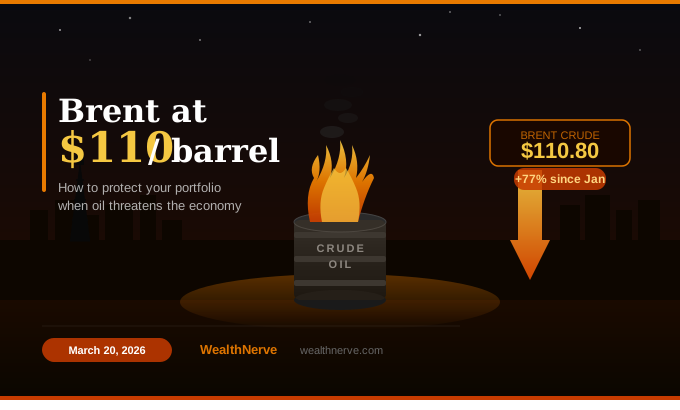
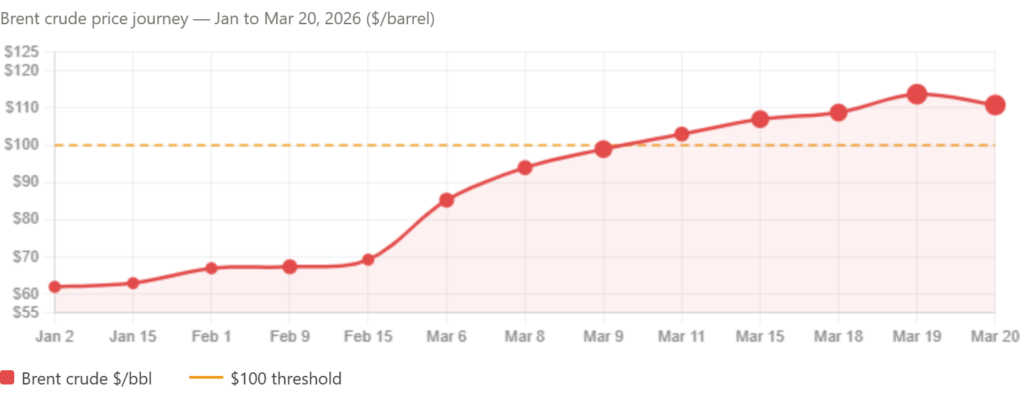
The price trajectory has been breathtaking. Brent had already climbed from $62.18 on January 2 to $85.28 by March 6 — a $23.10 move in nine weeks driven by tightening fundamentals, not just headlines. U.S. Department of the Treasury Then the conflict escalated. By the morning of March 18, Brent was sitting at $108.78 per barrel — roughly $38 more than at the same time last year. Yahoo Finance And on March 19, Brent briefly rose above $119 per barrel before pulling back to $110.80 — still a 3.2% rise from the prior day. Bloomberg
Why This Isn’t Just a Short-Term Spike
The natural question every investor asks right now: is this a short-lived war premium that fades, or is $100+ oil the new normal for 2026?
The honest answer is: probably somewhere in between, but the risks are skewed toward “higher for longer.”
Three structural forces keep oil elevated. First, a Hormuz closure is not a pipeline outage that gets patched in days — commercial shipping and insurance markets are withdrawing from the region, which means even partial reopening takes months to normalize tanker routing and premiums. Second, Strategic Petroleum Reserve capacity is limited, constraining the policy response that blunted prior spikes. U.S. Department of the Treasury
The EIA’s own forecasts reflect this. The U.S. Energy Information Administration forecast that Brent crude will remain above $95 per barrel over the next two months, before gradually falling as the conflict eases — but notes that this forecast is “highly dependent on modeling assumptions of both the duration of conflict and resulting outages in oil production.” CNBC
Wall Street is divided. Analysts tracking the Hormuz disruption are forecasting WTI to remain at elevated levels through the year — Barclays sees $85 a barrel, Goldman Sachs set their target at $71, and Macquarie Group has called for as high as $150. U.S. Department of the Treasury That’s an enormous range, which tells you something important: nobody actually knows how long this lasts.
Oil traders don’t think $100 oil is here to stay — looking forward to contracts for 2027 and 2028, oil futures are trading in the high $60s. TRADING ECONOMICS But between now and then, investors need a strategy for navigating this environment.
How Oil at $110 Flows Through the Entire Economy
This isn’t just a story about gas prices. High oil ripples into almost everything:
Your gas bill. US gas prices have risen about 50 cents in a week to $3.48 a gallon, higher than at any point in either of President Donald Trump’s terms. TRADING ECONOMICS Crude oil usually accounts for more than half of the price per gallon, and sharp increases in oil almost always show up quickly at the pump — while declines often translate into slower, more delayed drops, known as the “rockets and feathers” effect.
Inflation. Higher energy costs feed into the price of almost every manufactured good and service. This is the mechanism that turns an oil shock into a broader inflation problem — and it’s exactly why the Fed is now paralyzed. Traders are now betting on a nearly 5% chance the Fed could hike its main interest rate by the end of the year and a roughly 80% chance that it will at least hold steady — whereas just a month ago, those same traders were betting on a 74% probability of two or more cuts.
Global stocks. Stocks in Asia fell sharply as investors braced for the fallout from rising energy prices — Japan’s Nikkei 225 closed more than 5% lower, South Korea’s KOSPI was down 6%, and US S&P 500 futures fell 1.7%.
Maritime insurance. The cost of maritime insurance for tankers in the Gulf has increased tenfold, with most major shipping lines ordering their fleets to drop anchor in safe waters outside the Gulf of Oman. TheStreet These costs eventually get priced into everything shipped globally.
The Winners: Where Smart Money Is Flowing Right Now
Not every investor is losing in this environment. Here’s where the money is actually going:
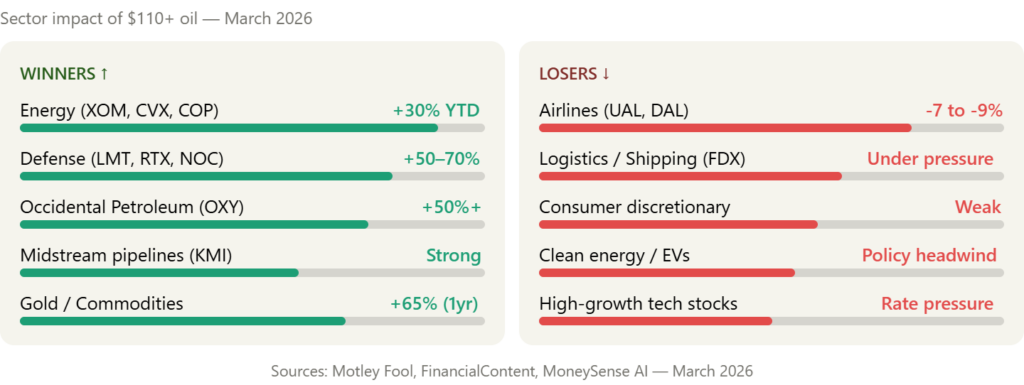
Big Oil — the obvious play. The shares of oil giants ExxonMobil (XOM), Chevron (CVX), and ConocoPhillips (COP) are all up roughly 30% on the year. ExxonMobil and Chevron both saw their stock prices jump by more than 6% in a single day of early trading as investors bet on the increased value of their non-Middle Eastern assets.
Pure-play E&P companies outperform even the majors. Occidental Petroleum (OXY) has delivered the highest return among energy names, exceeding 50% — compared with more modest gains from larger integrated companies like ExxonMobil where downstream operations face margin pressure from high refined product costs.
Defense stocks. In the 2022–2026 conflict era, major defense names including Lockheed Martin (LMT), RTX Corporation (RTX), and Northrop Grumman (NOC) have gained 50–70%+, with the ITA iShares U.S. Aerospace and Defense ETF serving as the simplest vehicle for broad exposure.
Energy as a stagflation hedge. Historically, energy has been one of the few sectors to outperform during periods of stagflation — characterized by slow economic growth and high inflation. In the current market, energy equities are providing a “double-ended” hedge: protection against the rising cost of living and the risk of global supply disruptions.
The Losers: What to Reduce or Avoid
The losers in this environment are primarily found in the consumer discretionary and transportation sectors. Airlines and logistics companies are seeing their margins decimated by jet fuel and diesel costs that have spiked nearly 40% in some regions since January.
United Airlines (UAL) and Delta Air Lines (DAL) saw their shares tumble by 7% and 9% respectively, as the prospect of sustained $110+ oil threatens to erase profit margins for the fiscal year. Global logistics giants like FedEx (FDX) are also under pressure, as the cost of international freight is expected to rise sharply. TheStreet
Tech companies that rely on cheap capital are also finding themselves sidelined as the Federal Reserve is forced to keep interest rates higher for longer to combat the energy-driven inflationary surge. FinancialContent High-multiple growth stocks — the ones that need low rates to justify their valuations — face a particularly difficult environment.
Clean energy is also struggling: under the current administration, which favors fossil fuel expansion, clean energy faces reduced subsidies and policy support, and during conflict periods where the “energy independence” narrative drives investment toward domestic oil and gas, clean energy often gets left behind.
What Should You Actually Do With Your Portfolio?
Here’s a practical framework for navigating $110 oil as a retail investor:
1. Add energy exposure if you haven’t yet. The XLE (Energy Select Sector SPDR ETF) gives you broad exposure to all the major energy names in a single trade. For higher upside (and higher risk), individual names like OXY, DVN, or COP have more torque to oil prices than the integrated majors.
2. Don’t panic-sell airlines completely. Airlines are one of the most consistent wartime losers, but they often recover strongly when conflicts end — so short-term weakness can create buying opportunities for patient investors if conflict resolution seems near. Watch the diplomatic signals carefully.
3. Hold or add gold. Gold is performing its traditional role as a geopolitical hedge and inflation store of value simultaneously. In an environment where the Fed can’t cut rates and oil is feeding inflation, gold tends to hold its ground.
4. Shorten your bond duration. The two-year Treasury yield touched its highest level since the summer, rising to 3.81%, while the 10-year Treasury yield held at 4.26% — up from just 3.97% before the war with Iran started. Bloomberg Longer duration bonds lose more value as rates rise, so shortening duration or moving into TIPS is the prudent move.
5. Watch the EIA weekly inventory reports. Released every Wednesday, these give the clearest real-time signal of whether the supply crunch is easing or tightening. A surprise inventory build would be a signal that the price spike is near its peak.
Key Takeaways
- Brent crude surged from $62 at the start of 2026 to briefly above $119, driven by the near-closure of the Strait of Hormuz following the US-Israel war with Iran
- The EIA forecasts prices remaining above $95/bbl in the near term, with the outlook “highly dependent” on conflict duration and production outages CNBC
- Winners: Energy majors (XOM, CVX, COP), pure-play E&Ps (OXY, DVN), defense (LMT, RTX), gold, and pipelines
- Losers: Airlines, logistics companies, consumer discretionary, high-growth tech, and clean energy
- The Fed is now effectively frozen — rate cuts in 2026 are off the table, with rate hike bets rising
- Long-duration bonds face pressure; shorten duration or move to TIPS
- Watch Wednesday EIA inventory reports as your real-time barometer
Frequently Asked Questions
Q: Will oil prices stay above $100 for the rest of 2026? Analysts are divided, but the structural case for “higher for longer” is credible given that Hormuz re-opening takes months to normalize, not days. The EIA forecasts elevated prices through at least Q2 2026 before a gradual decline. Futures markets are pricing oil back in the $60s by 2027–2028, but a lot depends on how quickly the conflict de-escalates.
Q: Should I buy oil stocks now even though they’ve already risen 30%? The majors (XOM, CVX, COP) have risen roughly 30% but lag far behind the ~70% rise in crude itself — reflecting the market’s belief that high oil won’t last. If you believe the disruption persists through mid-2026, there’s still a credible case for energy stocks. Just size your position appropriately, as these are high-beta plays relative to oil price moves.
Q: Is this the same as the 1973 oil shock? There are similarities — a Middle East conflict, a supply disruption affecting global trade, and stagflationary pressure on the economy. But the world today has far more alternative supply (US shale, Brazil, Canada) than in 1973, and digital tools and renewable energy reduce some oil dependency. The shock is severe, but the structural economy is more resilient than 50 years ago.
Q: What is the Strategic Petroleum Reserve and can it help? The U.S. maintains a stockpile of crude oil known as the Strategic Petroleum Reserve, whose main goal is to safeguard energy security when disasters strike — such as sanctions, severe storm damage, or war. It can ease the pain of sudden price jumps when supply gets disrupted, but it is not a permanent fix and more of an immediate safety net. The G7 and IEA are already discussing coordinated releases.
Q: Which ETF is the simplest way to get energy exposure? XLE (Energy Select Sector SPDR ETF) is the most liquid and widely held energy ETF, giving exposure to the top US integrated majors. For broader global energy exposure, IXC (iShares Global Energy ETF) includes international names. For defense exposure, ITA (iShares US Aerospace and Defense ETF) is the go-to.
⚠️ Disclaimer: This article is for informational and educational purposes only and does not constitute financial advice. All investment decisions carry risk. WealthNerve recommends consulting a qualified financial advisor before making investment decisions. Past performance is not indicative of future results.