
If you’ve ever done an SIP, chances are you’ve done it with SBI Mutual Fund. And now, India’s largest asset management company — the one quietly managing ₹12.63 lakh crore of your money — is finally going public.
On March 19, 2026, SBI Funds Management Limited filed its Draft Red Herring Prospectus (DRHP) with SEBI, initiating the process for its proposed Initial Public Offering — a milestone that makes it India’s most anticipated financial listing of the year.
This post breaks down everything you need to know: what the IPO is, who is selling, what the company is worth, how it compares to peers, and — most importantly — whether you should apply.
What Is the SBI Mutual Fund IPO?
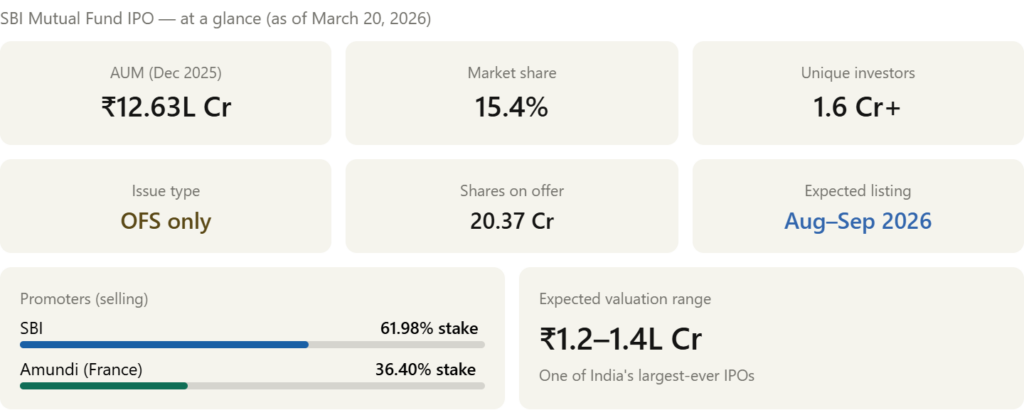
First, let’s get the structure right. SBI Funds Management is the country’s largest asset management company, with a quarterly average mutual fund AUM of nearly ₹12.5 lakh crore as of December 2025, holding a 15.4% share in the mutual fund market.
The company you’re being invited to invest in is not SBI the bank — it’s SBI Funds Management Ltd (SBIFML), the legal entity that runs SBI Mutual Fund’s ₹126 schemes across equity, debt, hybrid, ETFs, and overseas funds.
SBI Funds Management Ltd is a joint venture between State Bank of India, which holds 61.98%, and Paris-based Amundi — Europe’s largest asset manager — which holds 36.40%. After listing, you’d be buying a slice of this joint venture.
Key IPO Details You Need to Know
The IPO will be entirely an Offer for Sale (OFS) of up to 20.37 crore equity shares of face value ₹1 each — with no fresh issue component, meaning the company itself will receive zero proceeds from the offering. Every rupee raised goes to the promoters who are selling.
Specifically, State Bank of India will offload up to 12.83 crore shares, while Amundi India Holding will sell up to 7.53 crore shares as part of the OFS. The weighted average cost of acquisition stands at ₹0.15 per share for SBI and ₹4.35 per share for Amundi. Both are selling at what will almost certainly be thousands of rupees per share — which tells you how spectacularly profitable this business has been for them.
SBI Chairman CS Setty confirmed that the DRHP would be filed by March and that the plan is to complete the entire listing process by September 2026. The merchant bankers appointed to manage the issue include Kotak Mahindra Capital, Axis Capital, BofA Securities India, HSBC Securities, ICICI Securities, Jefferies India, JM Financial, Motilal Oswal Investment Advisors, and SBI Capital Markets CommunityAmerica Credit Union — a who’s who of Indian and global investment banking.
Why Is This a Big Deal for Indian Investors?
The timing of the IPO is not accidental — India is witnessing a structural shift from traditional savings like fixed deposits and gold to market-linked instruments such as mutual funds, with monthly SIP inflows at record highs and investor participation expanding rapidly across Tier-2 and Tier-3 cities.
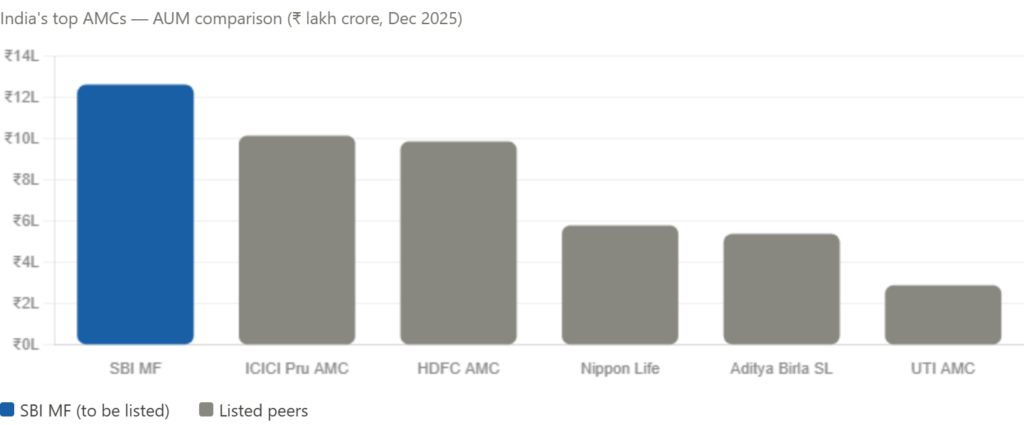
SBI Mutual Fund sits at the very centre of this wealth-creation revolution. Established in 1987, SBI Mutual Fund was the first domestic non-UTI mutual fund in India, and it is also the country’s largest passive asset manager with ETF and index fund AUM of ₹3.99 lakh crore — reflecting a passive market share of 29.6% as of December 2025.
In simpler terms: if India’s mutual fund story is one of the great investment themes of the next decade, SBI Mutual Fund is the biggest single beneficiary of that story.
How Does It Compare to Listed Peers?
This is where things get interesting — and where investors need to be clear-eyed. Listed asset managers often trade at P/E multiples of 37–45x. HDFC Asset Management Company trades around 37.5x to 45x P/E, Nippon Life India Asset Management at about 37.86x, and ICICI Prudential AMC saw IPO valuations between 32x and 40x.
SBI Mutual Fund, by contrast, is currently trading at a P/E multiple of approximately 54x in the unlisted market — higher than HDFC AMC at 41.6x and Nippon India at 40.9x. Fortune Whether the public market will support this premium is the key question every investor needs to answer.
The most useful recent benchmark is ICICI Prudential AMC. ICICI Prudential AMC’s IPO ran from December 12–16, 2025 at a price band of ₹2,165 per share and listed on December 19, 2025 at ₹2,600 — delivering a listing gain of 20.09%. RBC If SBI MF’s final price band is set at a reasonable discount to its unlisted market price, a similar listing pop is plausible.
The Case For and Against Applying
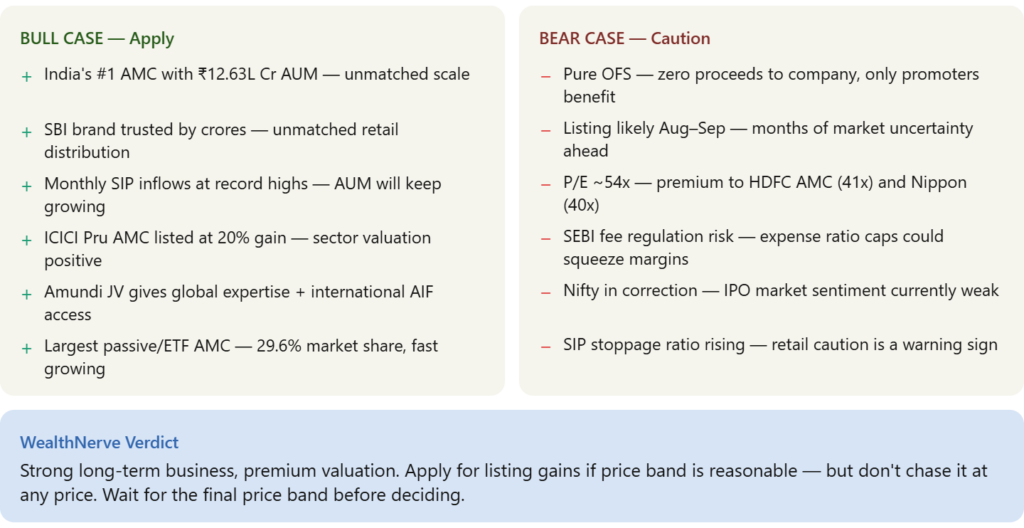
Why you should be excited: SBI MF’s scale is genuinely unmatched. Being the largest AMC in India gives SBI Mutual Fund significant pricing power and investor trust, and the combination of SBI’s domestic reach and Amundi’s global expertise creates a distribution moat that newer players simply cannot replicate. The asset management business is also an extraordinarily capital-light model — as AUM grows, revenue grows faster than costs, making it one of the most scalable businesses in Indian finance.
Why you should be cautious: The OFS-only structure is a genuine concern. Since there is no fresh issue, the company will not receive any funds for expansion or future growth initiatives — all proceeds go to the promoters who are exiting at what they have clearly decided is a favourable valuation. When insiders are sellers, it pays to ask why.
The Indian mutual fund industry’s total AUM reached ₹82.03 lakh crore by February 2026 — but a rising SIP stoppage ratio suggests growing caution among retail investors, and potential SEBI regulatory changes such as caps on fees could impact asset manager margins industry-wide.
Market timing also matters. The IPO is expected around August–September 2026, when the current market turbulence — driven by oil prices, FII selling, and the HDFC Bank governance shock — may or may not have resolved. A weak market at the time of listing could suppress both pricing and listing gains.
What Happens to SBI Bank’s Stock?
For existing SBI shareholders, the IPO filing was unambiguously positive. SBI shares rallied as much as 3.44% to ₹1,085 apiece on the NSE in early trade on March 20, as markets priced in the value unlocking from the listing of its AMC subsidiary. SBI holds its stake at a cost of just ₹0.15 per share — meaning virtually every rupee of sale proceeds is pure profit for the bank.
How to Track and Apply for This IPO
Since the DRHP was just filed on March 19, here is the exact timeline to track:
Step 1 — SEBI observation letter: SEBI typically takes 30–75 days to process the DRHP and issue observations. Expect this around May–June 2026.
Step 2 — Red Herring Prospectus (RHP): Once SEBI clears it, SBI MF will file the final RHP with the price band and lot size — this is when you’ll know what you’re actually paying.
Step 3 — IPO subscription window: Typically open for 3 days. Apply via ASBA through your bank or broker (Zerodha, Groww, Upstox, Angel One all support this).
Step 4 — Allotment and listing: Allotment within 3 working days of close, listing on BSE and NSE shortly after. The target listing date is September 2026.
Our advice: Bookmark this page, set a Google Alert for “SBI Mutual Fund IPO price band,” and wait for the RHP before committing. The business quality is not in question — the valuation is.
Key Takeaways
- SBI Funds Management filed its DRHP with SEBI on March 19, 2026 — offering 20.37 crore shares entirely via OFS with no fresh issue component
- India’s largest AMC with ₹12.63 lakh crore AUM and a 15.4% market share — unmatched scale in the Indian mutual fund industry
- Joint venture between SBI (61.98%) and Amundi (36.40%) — both promoters are sellers in this IPO
- Expected valuation of ₹1.2–1.4 lakh crore — one of India’s largest-ever IPOs
- Unlisted market P/E of ~54x is a premium to listed peers HDFC AMC (41x) and Nippon (40x) — valuation discipline matters
- ICICI Prudential AMC delivered a 20% listing gain in December 2025 — a useful benchmark for expected returns
- Expected listing: August–September 2026. Wait for the final price band before deciding to apply
Frequently Asked Questions
Q: Is the SBI Mutual Fund IPO good for long-term investors? The business fundamentals are excellent — India’s mutual fund penetration is still low compared to developed markets, and SBI MF is the dominant player. For long-term investors, the quality of the business is not in doubt. The only question is whether the IPO price will leave adequate upside on the table.
Q: Should I apply for listing gains? Too early to say without the price band. If SBI MF prices the IPO at a reasonable discount to fair value (similar to what ICICI Prudential AMC did), the 10–20% listing gain trade is credible. If it prices aggressively at ₹1.4 lakh crore valuation, the margin of safety shrinks significantly.
Q: What is an OFS and why does it matter? An OFS (Offer for Sale) means existing shareholders — here, SBI and Amundi — are selling their shares to public investors. The company itself raises no money. It matters because it signals that insiders believe the current valuation is attractive for selling, not buying. This isn’t automatically bad, but it’s worth noting.
Q: How do I apply for the IPO when it opens? Through the ASBA (Application Supported by Blocked Amount) route via your bank’s net banking portal, or via your broker app (Zerodha, Groww, Upstox, Angel One). The money is blocked — not debited — until allotment, so there’s no risk of losing interest.
Q: What is the minimum investment likely to be? The lot size and price band haven’t been announced yet. Based on the expected valuation and peer comparisons, the price per share is likely to be in the range of ₹600–₹800, with a lot size of approximately 19–20 shares — making the minimum application around ₹12,000–₹16,000.
⚠️ Disclaimer: This article is for informational and educational purposes only and does not constitute financial or investment advice. IPO investments carry market risk. WealthNerve recommends reading the DRHP carefully and consulting a SEBI-registered financial advisor before applying. Past listing performance of peer companies is not a guarantee of future results.