You’ve probably heard someone say “the market crashed today” or “I made money in stocks.” Maybe you’ve seen red and green numbers flashing on a news channel and thought — what on earth is going on?
Don’t worry. By the end of this lesson, you’ll understand exactly what the stock market is, why it exists, and why millions of people use it to build wealth. No confusing jargon. No prior knowledge needed. We start from zero.
What is a “Stock”? Let’s Start Here.
Before we talk about the market, let’s understand what a stock actually is.
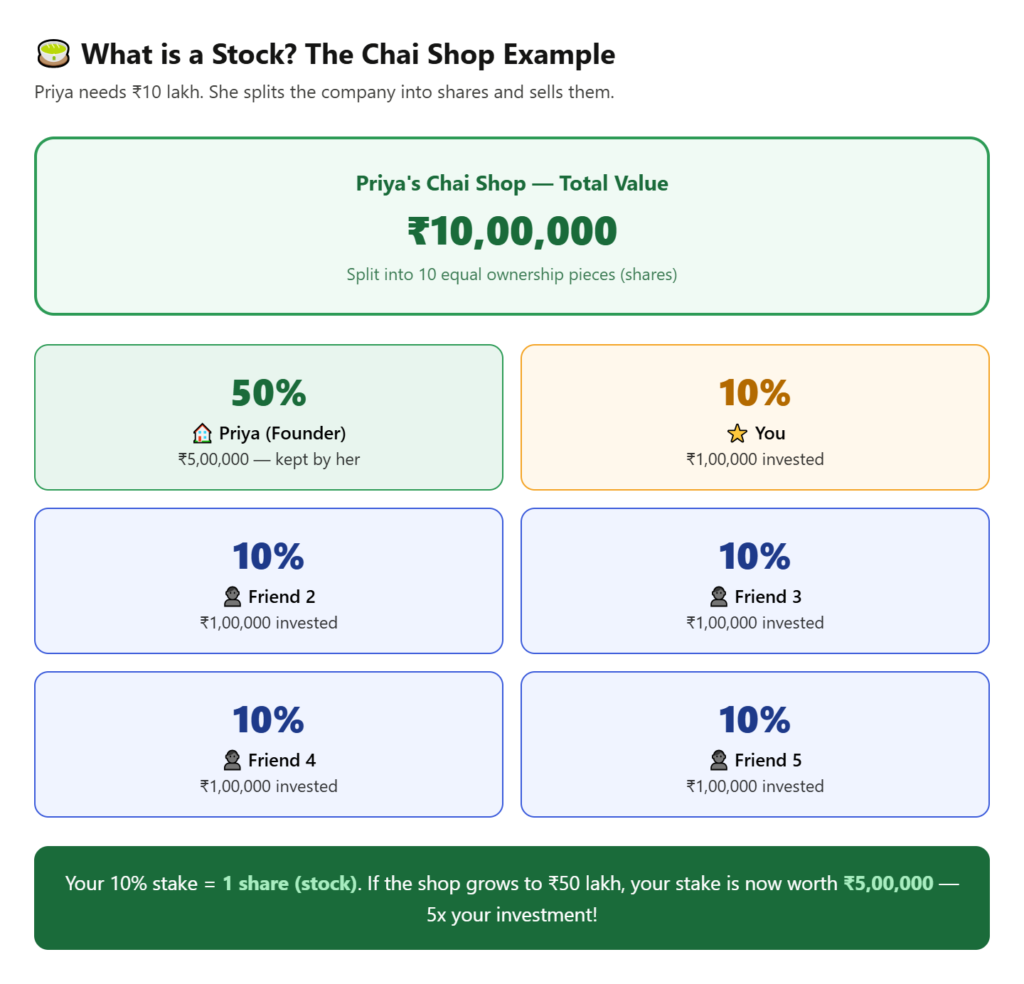
Imagine your friend Priya wants to open a chai shop. She needs ₹10 lakh to get started — for rent, equipment, staff, and supplies. But she only has ₹5 lakh saved up.
So she comes to you and four other friends and says:
“Invest ₹1 lakh each in my chai shop. In return, I’ll give each of you 10% ownership of the business.”
You agree. You give her ₹1 lakh. She gives you a document that says: “You own 10% of this chai shop.”
That document — that proof of ownership — is essentially what a stock is.
In the real world, instead of a paper document, it’s a digital record stored in your investment account. But the concept is identical.
Now here’s the exciting part:
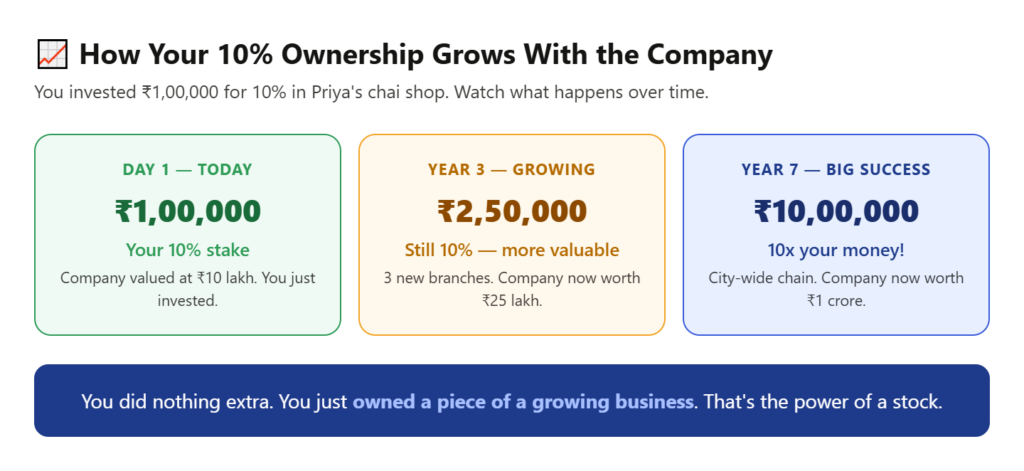
If Priya’s chai shop does well and earns big profits — you earn too. If she opens 10 more branches and the business becomes very valuable — your 10% ownership becomes worth much more than your original ₹1 lakh.
That’s a stock. A stock is simply a small piece of ownership in a company.
So, What is the Stock Market?
Now imagine this at a massive scale.
Instead of Priya’s chai shop, think of thousands of companies — Reliance, TCS, HDFC, Apple, Tesla, Amazon — all offering pieces of their business to the public.
And instead of five friends, imagine millions of people all over the world — everyday investors, big institutions, pension funds — all wanting to buy or sell these pieces of ownership.
You’d need a central, organized, safe place where all of this could happen, right?
That’s exactly what the stock market is.
The stock market is a regulated marketplace where people buy and sell ownership pieces (stocks) of companies.
In India, we have two major stock exchanges:
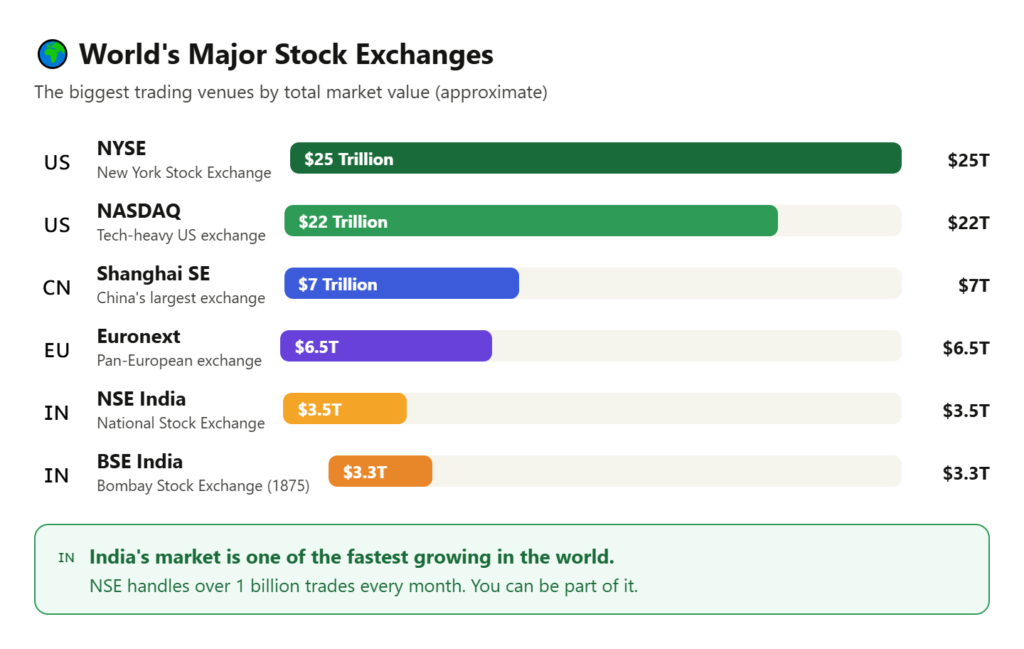
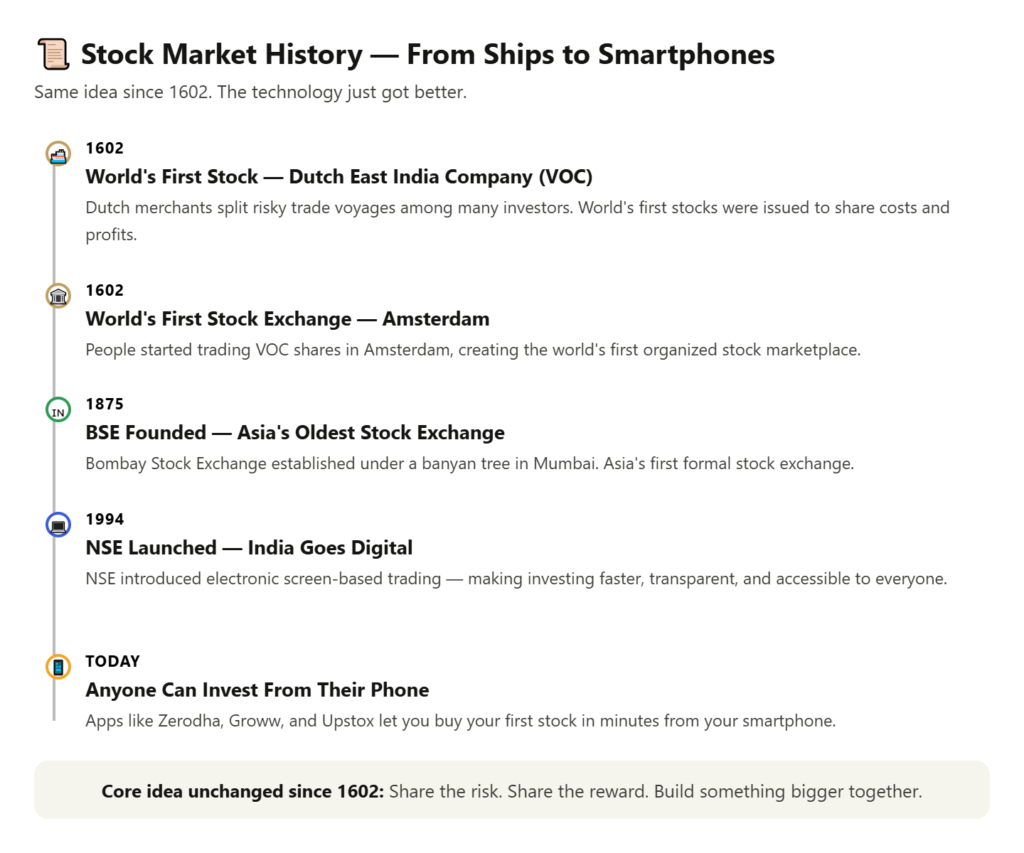
- BSE (Bombay Stock Exchange) — Asia’s oldest, established in 1875
- NSE (National Stock Exchange) — India’s largest by trading volume
In the US:
- NYSE — New York Stock Exchange
- NASDAQ — Known for tech companies like Apple and Google
Think of a stock exchange as the venue — the organized marketplace where all the buying and selling happens, with a rulebook everyone must follow.
A Quick Bit of History (This Makes It All Click)
Let me tell you a quick story from 400 years ago that makes everything make sense.
Back in the 1600s, Dutch merchants wanted to build massive ships to sail to Asia and bring back spices, silk, and gold. These voyages were incredibly expensive — and risky. Ships could sink. Pirates were real.
No single merchant could afford to fund an entire voyage alone.
So they came up with a brilliant idea: “Let’s split the cost — and the profit — among many people.”
This led to the creation of the Dutch East India Company (VOC) in 1602 — the world’s first publicly traded company. They issued the world’s first stocks. People could buy and sell them at what became the world’s first stock exchange in Amsterdam.
Four hundred years later, the concept is exactly the same:
- Companies need money to grow
- They offer ownership to the public
- People invest hoping to share in the profits
- A regulated marketplace makes it all happen safely
Why Do Companies List on the Stock Market?
Companies don’t have to go public. Many businesses stay private forever. So why do some choose to list on the stock exchange?
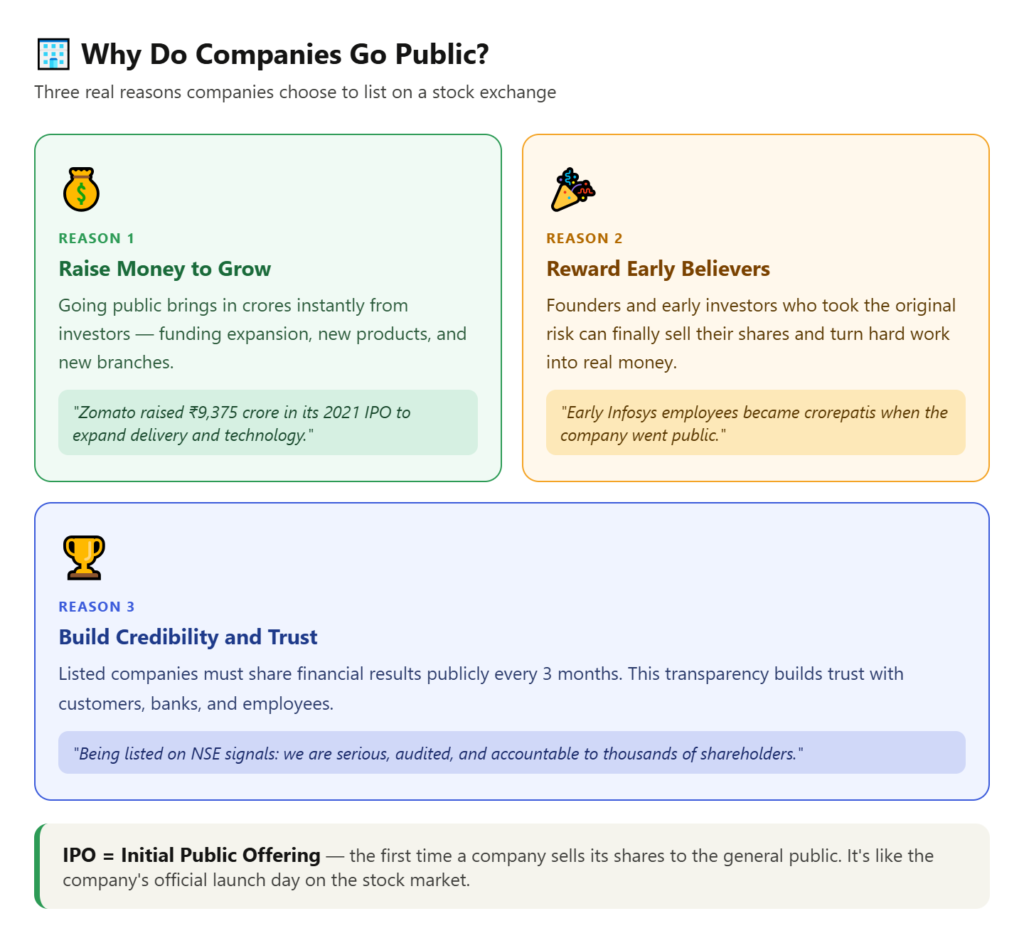
Reason 1: To Raise Money for Growth
When a company offers shares to the public for the first time — called an IPO (Initial Public Offering) — it receives a large sum of money from investors. This money funds expansion, new products, new branches, or paying off old debt. Zomato, for example, raised ₹9,375 crore in its 2021 IPO.
Reason 2: To Reward Early Investors
The founders and early investors who took the original risk deserve a reward. Going public lets them sell some of their shares and turn their paper wealth into real money. Early Infosys employees became crorepatis this way.
Reason 3: To Gain Credibility
Listed companies must share their financial results publicly every 3 months. This transparency builds trust with customers, banks, and employees.
Why Do People Buy Stocks?
Here’s where it gets exciting for you as a potential investor.
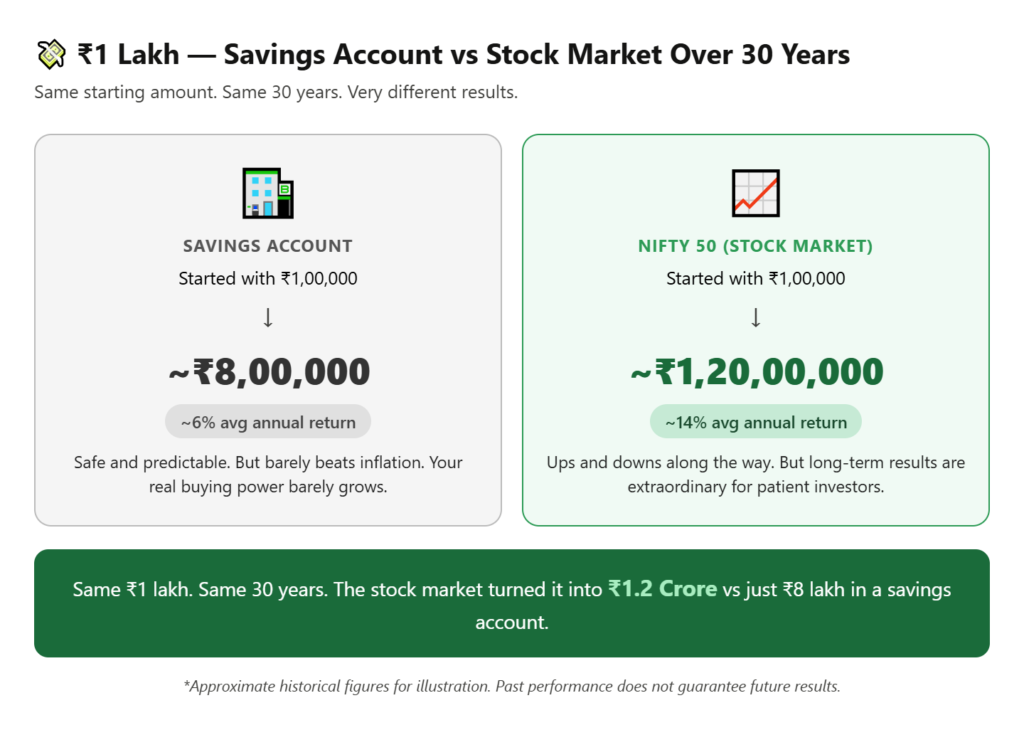
Grow Your Money (Capital Appreciation) If a company grows, its stock price goes up. Buy a stock at ₹100. It rises to ₹400. You’ve made 4x your money.
Earn Regular Income (Dividends) Some companies share a portion of profits with shareholders regularly. It’s like a “thank you” payment just for owning the stock.
Beat Inflation Money sitting in a savings account loses value over time due to inflation. Stocks have historically grown much faster than inflation over the long run.
Build Long-Term Wealth The stock market has made more ordinary people wealthy than almost any other investment vehicle in history. ₹1 lakh invested in Infosys during its 1993 IPO would be worth several crores today. The same money in a savings account? Maybe ₹8–10 lakh.
How Does a Stock Price Go Up or Down?
This is the question every beginner asks. Why does a price change every second?
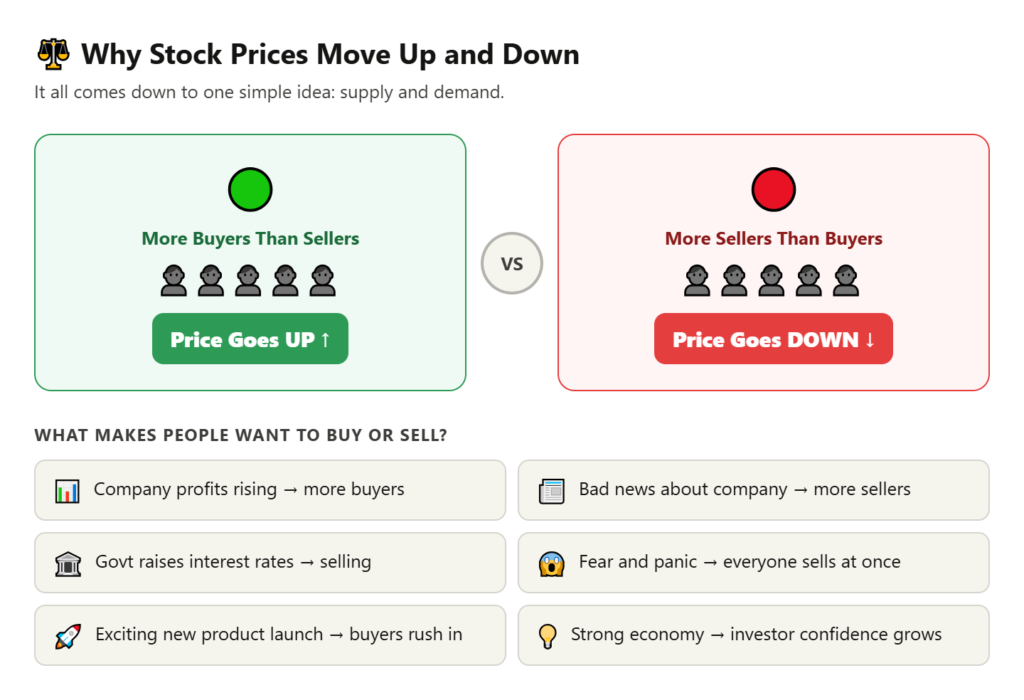
Simple answer: Supply and Demand.
- If more people want to BUY a stock than sell it → price goes UP
- If more people want to SELL a stock than buy it → price goes DOWN
It’s the same principle as any market. Mango season ends, fewer mangoes available, price goes up. Simple.
But what drives people to buy or sell in the first place?
- Company earnings — is the business growing and making profit?
- News about the company or industry
- Government policies and interest rates
- Global events like pandemics, wars, or elections
- Investor emotions — fear and greed
We’ll go deep into all of these in future lessons. For now, just remember: stock prices move based on how people perceive the value of a company at any given moment.
Is the Stock Market the Same as Gambling?
This is the biggest misconception beginners have. Let’s settle it right now.
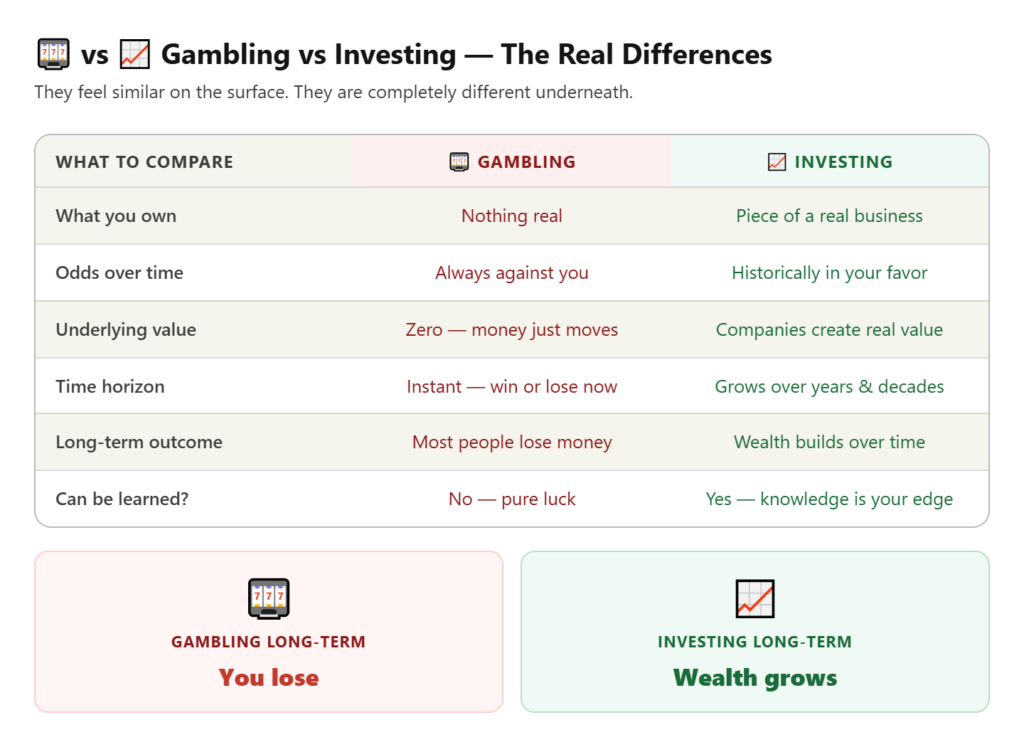
No. Investing in stocks is NOT gambling — when done with knowledge.
Here’s the key difference:
Gambling:
- The odds are always against you
- You win only if someone else loses
- No real value is being created
- Long-term outcome: most people lose money
Investing in Stocks:
- You own a piece of a real business
- Companies create real products and earn real profits
- Over long periods, the economy grows and everyone with ownership benefits
- Long-term outcome: historically, wealth builds for patient investors
Can you lose money in stocks? Yes — if you trade recklessly, follow random tips, or panic during a market crash. That’s exactly why this course exists.
The Big Picture (Before We Wrap Up)
Here’s something powerful to sit with.
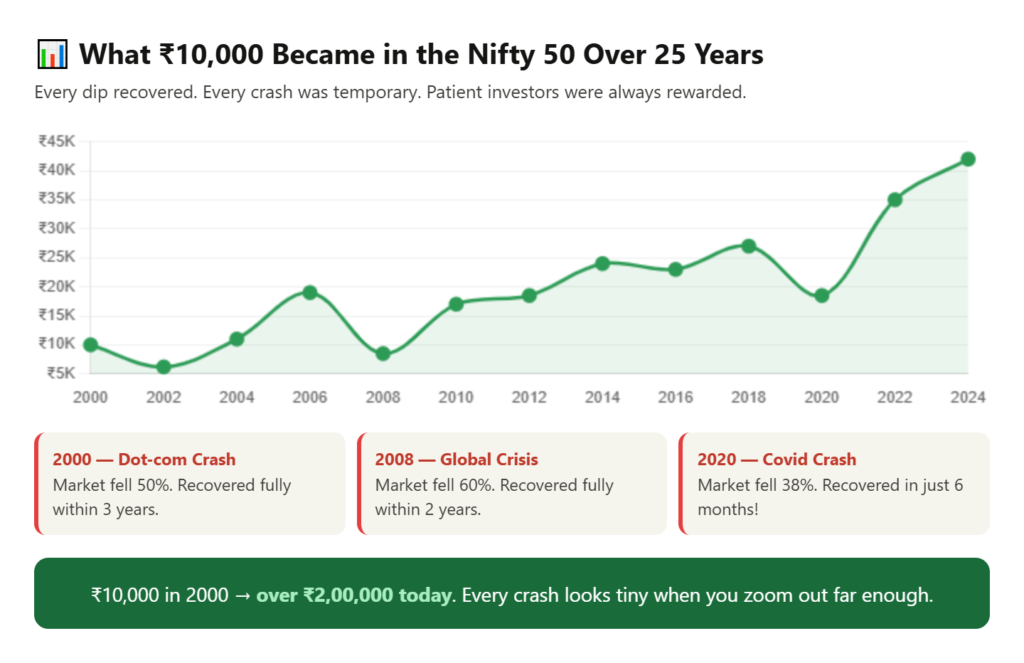
If you had invested ₹10,000 in the Nifty 50 index 25 years ago and just left it there — no checking every day, no panicking during crashes — it would be worth over ₹2,00,000 today.
You didn’t need to be a genius. You didn’t need to pick the perfect stock. You just needed to start, stay patient, and let time do its work.
That’s the magic of the stock market. And that’s exactly what this course will teach you to do — wisely.
⚡ Quick Recap
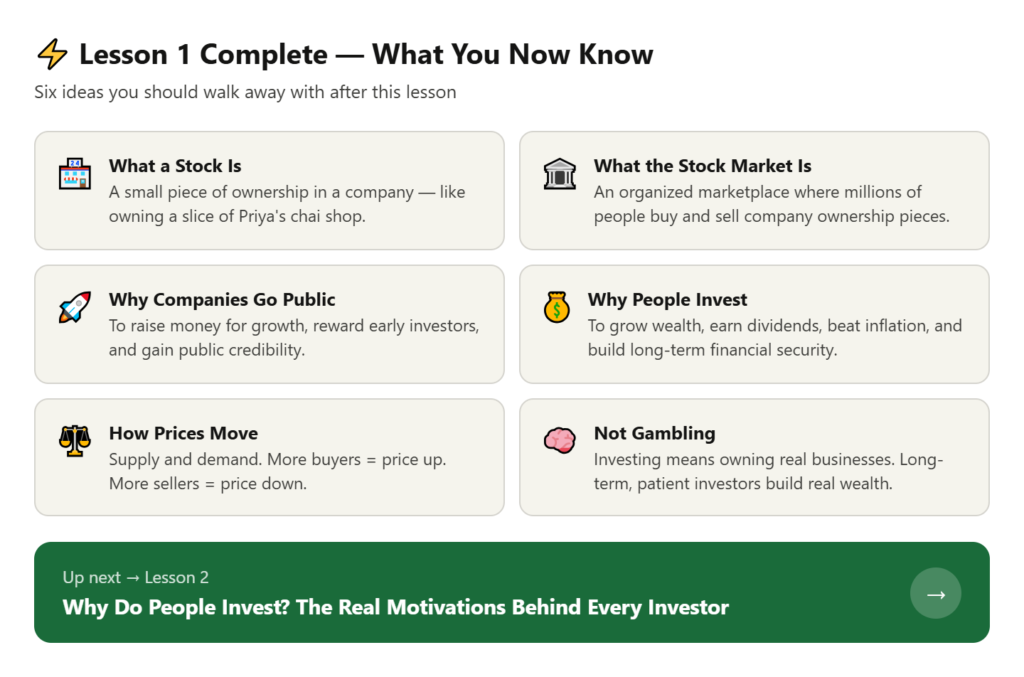
- A stock = a small piece of ownership in a company
- The stock market = an organized marketplace to buy and sell stocks
- Companies go public to raise money and fuel growth
- Investors buy stocks to grow wealth, earn dividends, and beat inflation
- Prices move based on supply, demand, and perception of value
- Investing is NOT gambling — it’s ownership of real businesses
❌ Beginner Mistakes to Avoid
Mistake 1: Confusing investing with trading Buying and selling every day is trading. Holding good companies for years is investing. They are completely different. Beginners should focus on investing.
Mistake 2: Expecting quick riches The stock market is a get-rich-slowly machine. Anyone promising overnight returns is either lying or about to lose all their money.
Mistake 3: Using money you can’t afford to lose Never invest money you’ll need in the next 1–2 years. Markets can and do fall in the short term.
✅ Your Action Step Today
Open Google. Search for “Nifty 50 historical chart” or “S&P 500 historical chart.”
Zoom out to 20–25 years.
Look at how the line goes up — despite recessions, pandemics, and crashes.
Let that chart sink in. That long upward trend over decades is your biggest reason to start investing.
💬 Think About These
- If you owned 5% of a company worth ₹1 crore today, and it grew to ₹10 crore in 5 years — what would your stake be worth?
- Name one company whose products you use every day. Would you invest in that company? Why?
- Why do you think most people are scared of the stock market, even though it has historically created enormous wealth?
Next Lesson → Lesson 2: Why Do People Invest? (The Real Reasons Behind Every Investor’s Decision)